

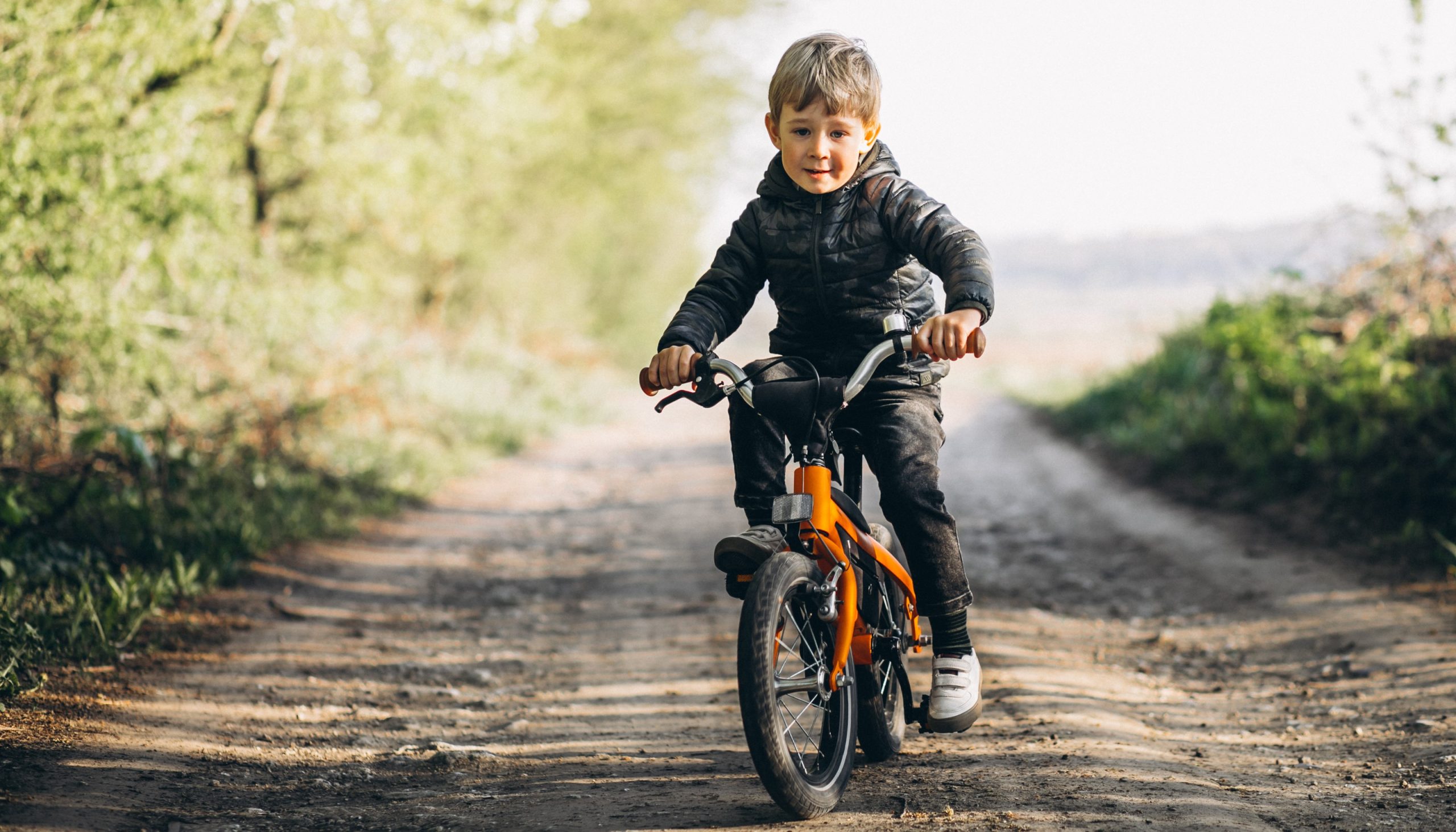
For years, many children learned to ride a bike with training wheels. Training wheels are a kind of scaffolding: they let a child practice steering and pedaling without tipping over. But they also remove the hardest skill from the teaching and learning experience: balancing. This shift in how we approach a challenge is essential for students in a world of artificial intelligence (AI).
Now, many kids learn to ride on balance bikes—without pedals or training wheels. Instead just a lightweight frame and two wheels. Children push along with their feet, coast, and put their feet down whenever fear bubbles up. From day one, they are scanning, steering, and adjusting. Pedals come later, once the hardest part has become embodied knowledge.
Ditch the crutch of training wheels
The balance bike is counterintuitive because it helps the learner by taking something away. Instead of adding more support, it removes the part that can distract from the central learning objective.
In school, many of our supports function like training wheels. Step-by-step worksheets. Overly rigid rubrics. “Model” essays that students reproduce more than they understand. These can help students produce something that looks correct, but they can also unintentionally prevent students from practicing the hardest work: managing uncertainty, making judgments, and adjusting course when things get messy.
Instructional technology and AI literacy
In a world of AI, that distinction matters even more because producing polished text or superficially correct answers is increasingly easy to outsource. What is becoming more valuable is the ability to navigate complexity, especially collaboratively as a group.
To use AI wisely, students will need to do the work that cannot be delegated:
- Choosing a direction: What is the question? The goal?
- Maintaining effort: Is it worth sticking with when it gets hard?
- Managing uncertainty: What’s my next move when I am not sure?
- Reading the terrain: Could feedback, evidence, or constraint change my next move?
- Working with a group: How do I listen deeply to create a whole that’s greater than the sum of our parts?
These are the same skills that are not only irreplaceable but also become more important in a world full of AI.
Progress your skillset with AI 🚀
Master these irreplaceable skills by learning directly from authors Peter Nilsson and Maya Bialik. Their webinar, How to Advance Your Practice with AI for Teaching and Learning, for practical strategies to elevate student agency.
“Bicycles for the mind”
Steve Jobs once said that the computer is a “bicycle for the mind.” Walking is incredibly inefficient compared to how other animals move. Biking makes our efforts go further, letting us reach places that were previously unreachable. If the computer is a bicycle, what is AI? Perhaps a car, a self-driving car, or even a teleportation machine.
For students who believe the purpose of an assignment is to hand in a final product, it is tempting to take a nap in the back of the self-driving car. There have always been these students. When Maya was teaching, she once tried to get students to set goals for themselves.
To explain the idea, she said:
Maya: “If you don’t know where you’re going, how will you know when you get there?”
Seventh-grade student: “When my mom pulls the car over and opens the door for me.”
It is not new for students to abdicate the responsibility of the driver’s seat. But it’s never been easier, and it’s never been more important to make sure students stay in the driver’s seat.

Learning design and the advantages of technology
To design learning experiences in a world of AI, we should consider AI as a balance bike. On a bike, students can get much further than they could on foot, and we should elevate our expectations accordingly. But the focus of riding the bike (using AI) should shift from pedaling to practicing balance: from lower-level production skills to navigating uncertainty, making judgments and interpretations, and adjusting course when things get messy.
And sometimes, it is important to realize when the learning objective requires not using AI.
In Travels with Charley: In Search of America (1962), John Steinbeck narrates the local character of the land he passes through as he drives small roads from town to town, meeting people and seeing sights of all sizes. Near the end of his trip, he grows weary and takes the newly constructed interstate highways home. It is faster and easier.
But he is unsettled. He reflects on what is gained and lost by these new roads:
“When we get these thruways across the whole country, as we will and must, it will be possible to drive from New York to California without seeing a single thing” (Steinbeck, 1962).
This is the great risk of instructional technology in our schools. If we only focus on the final product, we may reach the destination without “seeing a single thing.” We must ensure that teaching and learning remain a journey of discovery rather than just a high-speed commute.
Featured #1 Amazon New Release 🏆
Go Deeper with the Authors of Irreplaceable 💡
Ready to ensure your students stay in the driver’s seat? Discover how to balance technology and human judgment in Peter Nilsson and Maya Bialik’s acclaimed book Irreplaceable: How AI Changes Everything (and Nothing) in Teaching and Learning.
The future of teaching and learning
However, like a calculator, when used wisely, it can help students reach higher levels of thinking that were previously inaccessible. On the other hand, if used as a replacement for learning, it can provide an immediate escape (from learning) for students who are not invested.
How do we design learning experiences that encourage students to use AI to practice deeper, more creative thinking, rather than as a shortcut around it? These and many other topics are covered in our book. We look forward to engaging with you about this essential question for educators today.
Building student agency through every lesson
In the world of AI, our role as educators is shifting but remains essential. We are no longer just providers of information; we are designers of personalized learning experiences. By using AI today as a balance bike, we allow students to practice the “hardest work” of being human. This includes managing uncertainty and building student agency through every lesson.
The future of education isn’t about the newest app or the fastest “thruway” to an answer. It is about the ethics of AI in education and how we protect the journey of the learner. We look forward to engaging with you on these essential questions. Let’s ensure our students don’t just reach the destination—let’s make sure they see everything along the way.
Expand Your AI Knowledge 🌐
Looking for more ways to navigate the digital landscape? Check out these recent posts:
About the educators
Maya Bialik is the founder of QuestionWell, a program that creates research-aligned AI tools for education. A former middle school science teacher, Maya’s focus is on how AI can improve working conditions for teachers.
Peter Nilsson is an educator, writer, and musician whose work bridges education, creativity, and technology. A former head of school and award-winning teacher, he cofounded Athena Lab and edits The Educator’s Notebook, a newsletter on innovation in learning.