
Student achievement starts with rethinking school
In the spring of 2020, as makeshift classrooms took shape at kitchen tables, I found myself haunted by one persistent question: “What if?” The question still pops up when I read or write about education which, lately, has been daily. I’ve pushed the question to the back of my mind time and time again, telling myself, “it’s just too big to solve” or “who is going to listen to your ideas?” But now, I believe we are staring straight into the face of a coming education revolution, putting this question of “what if” front of mind . . .
Why education must change now for our students
It’s time for change, and many of us know it. This cannot wait. Let’s consider our present situation:
- According to the World Health Organization, “An estimated 1 in 7 children and adolescents aged 10 to 19 are affected by mental health conditions, with anxiety, depression, and behavioural disorders among the most common” (2024).
- Challenging behavior is becoming more regular and intense (Whalen, 2023).
- Test scores are down (Schwartz & Tomko, 2025), and absenteeism is problematic across the nation (U.S. Department of Education, 2025).
- Teachers and leaders are tired and frustrated—and some are so fed up they quit midyear (Peetz, 2023).
- Educators likely got into the profession to build relationships with students and help them grow, but time for that is limited due to increasing teacher responsibilities. Yet, relationships are what students need most (Davis, 2021).
- Families are seeing the importance of engagement (McCormick, 2024), and communities must consider new ways to educate their young for a looming future of never-ending change and careers that have not yet been created (Nakamoto, 2025).
It’s both exciting and completely scary, so with that, I dare to ask the question:
What if we—educators, leaders, families, researchers, technologists, and community members—came together around the shared purpose of doing what’s best for kids and student achievement? What if we built a future-focused education system where each learner gets what they need, when they need it, with urgency?
Lofty? Maybe, but hear me out.
Our kids are counting on us to collaborate and do what’s right in a way that helps them in the future. This responsibility falls not just on teachers but on each of us as members of society, as parents or guardians, and as experts in education and technology. Our children’s education should not be an us-versus-them issue. Instead, learners should be kept firmly at the center, with rings of support (family, teachers, community liaisons, etc.) surrounding them, working in concert for the success of the learner.
📺 Building the Future
Moving from a “lofty” vision to a student-centered reality requires collaboration and actionable strategies. Join us for this exclusive webinar to discover how to start building those rings of support and achieve quick wins for every learner in your school community. [Access the Webinar Here >>]
What research says works best for student learning
Maya Angelo said, “Do the best you can until you know better. Then when you know better, do better.” To do the best we can for our kids and maximize student achievement, we must use what we know works and do so with fidelity. Let me provide a few examples.
Example 1
We have solid research from giants such as John Hattie and Linda Darling-Hammond to guide teaching and learning. For instance, Hattie’s work tells us classroom discussions are highly effective, twice as effective, actually, as cooperative learning (Hattie, 2018). Darling-Hammond shared in a recent podcast, “We know now a lot about how to teach so that children learn. One of the things we know from brain science is that children learn by interacting, even more than they learn just by listening. And they learn through experience more deeply than they learn just by reading or listening” (The 180 Podcast, n.d.).
Example 2
We have access to frameworks of high-leverage practices that work for all teachers with all students. Backward design, for instance, is a “research-informed model” educators can use in planning to ensure alignment between learning goals, class activities, and class assessments (Yale Poorvu Center for Teaching and Learning, n.d.). Additionally, the Council for Exceptional Children has outlined 22 high-leverage practices categorized into “four domains: Collaboration, Data-Driven Planning, Instruction in Behavior and Academics, and Intensify and Intervene as Needed” (High-Leverage Practices for Students with Disabilities, 2024). These practices, initially outlined for teaching students with disabilities, are not only effective for students with IEPs, but evidence also shows they are effective for all students” (Nelson et al., 2022).
Example 3
Aceves and Kennedy wrote, “Students are not widgets to be created in conveyor belt fashion. Each student has strengths that need to be built upon and unique needs that need to be addressed” (2024). Strengths, interests, goals, and unique learning factors should be examined as well as the student’s baseline or present level to plan for instruction and learning. Consider the Zone of Proximal Development. Based on an individual student’s readiness, this is “where instruction is most beneficial, as it is when the task is just beyond the individual’s capabilities. Challenging tasks in this zone promote maximum cognitive growth, helping learners stretch their current abilities with appropriate support” (McLeod, 2025).
Honoring Each Learner 📖
These research-based practices and frameworks provide a strong foundation, but the real shift happens when we commit to honoring each learner as a unique individual with assets, aspirations, and needs that deserve our attention. This mindset transforms planning from a task into a responsibility rooted in equity. When we honor each learner, we create environments where all students can thrive.
How AI could unlock personalized learning at scale
“Decades of research (and intuition) pointed to the idea that kids could learn much more if the pacing adapted to the student and allowed each one to truly ace a subject (that is mastery learning).”
—Salman Khan
Picture a classroom where every student is engaged. Some are exploring topics they love, others are working in small groups—meanwhile, teachers use real-time insights to guide instruction. Learning is active, personalized, and purposeful—and designed to maximize student achievement and individual success. This is the future we can create. How? That’s where artificial intelligence comes in.
AI, with human oversight, can be used to:
- Plan for each individual student
- Determine the next right instructional step for a student
- Revise a passage to a student’s independent reading level
- Recommend student-specific adaptations to learning environments
- Write individualized learning plans
Salman Khan, founder of Khan Academy, supports these ideas, indicating in his most recent book, “…personalization in learning is an aspiration that we should strive for and… AI is going to play a big role in getting us there” (2024).
The future of learning isn’t waiting. It’s being shaped by the questions we ask today. So, what do you think?
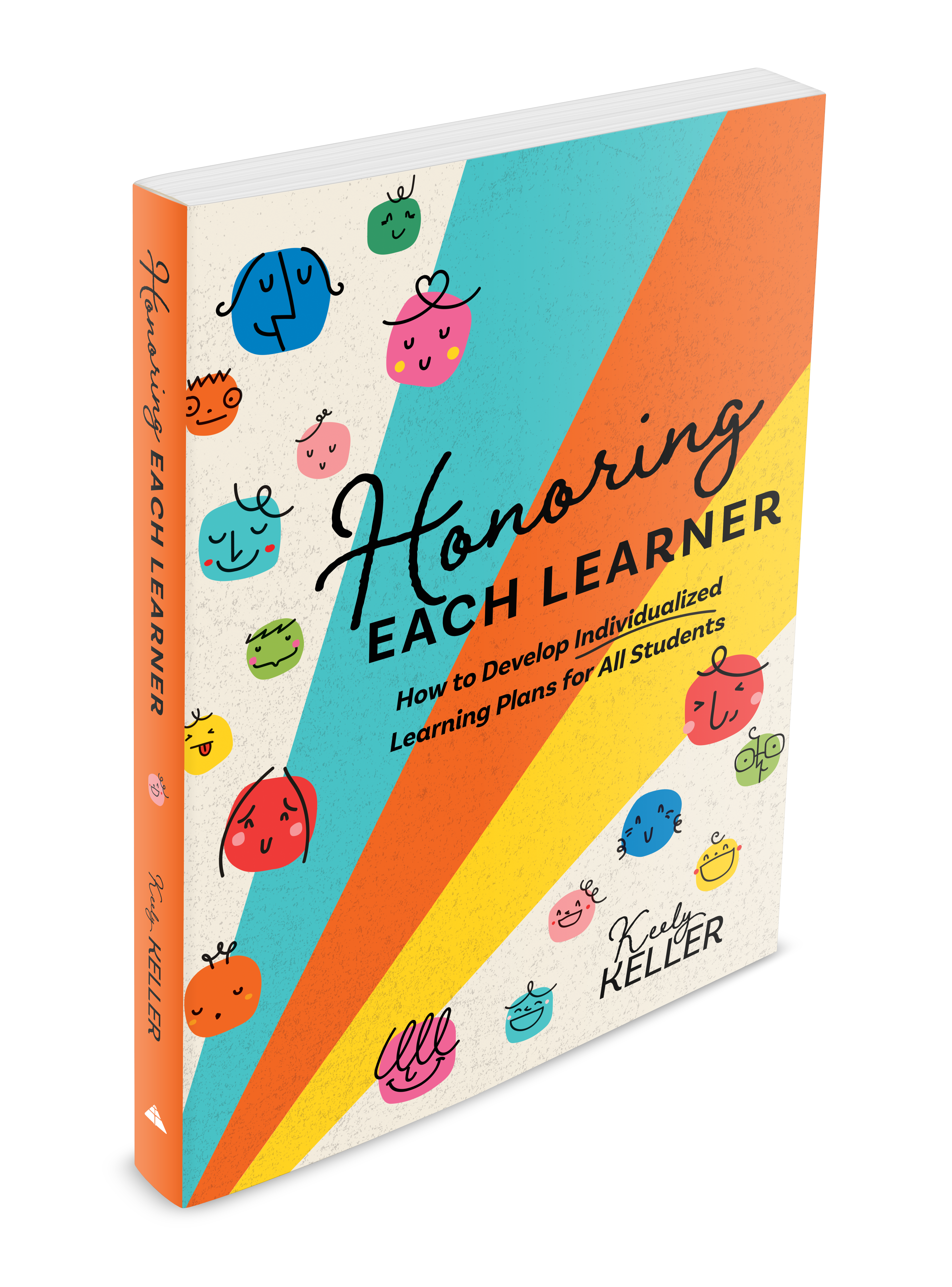 These are the kinds of questions I explore in my book, Honoring Each Learner: How to Develop Individualized Learning Plans for All Students. If the ideas in this blog stirred something in you, I encourage you to explore further because the future of learning starts with asking, “What if?”
Unlock student achievement and potential 🗝️
Learn how to implement essential, personalized, and differentiated instruction strategies that help all students thrive with these hand-picked blogs for further reading!
About the author
Keely Keller is an educator, leader, and writer dedicated to enhancing teaching and learning. As director of professional programs at K-12 Coalition, she develops resources and partnerships to empower educators. Keely specializes in special education, professional development, and evidence-based instructional strategies.