
When it comes to Individualized Education Plans (IEPs), are we enabling independence—or dependence? Too often, the conversation focuses on the student when, really, our first step is to take a hard look at how adults develop, implement, monitor, and adjust the plan to support meaningful growth.
It’s an uncomfortable question, but an important one: when a student has an IEP, are we ensuring meaningful access, or unintentionally building dependence?
How to help students, not hold them back
Students with diverse needs are absolutely entitled to the supports, services, accommodations, and protections outlined in their IEPs. That part should not be in question. The real issue is whether these supports are helping students access learning in ways that build confidence and independence—or unintentionally send the message, ‘You can’t do this without me.’
Too often, conversations in schools sound like this: ‘He can’t do that.’ ‘She’s not ready.’ ‘That’s too hard for him.’ Most of the time, those statements are spoken with concern or framed as realism. But our beliefs shape our decisions. If we start from limitation, we are more likely to build plans that restrict opportunity. When we start from possibility, we are more likely to create meaningful access without reducing opportunity.
Presuming competence does not mean ignoring student needs or pretending support is not necessary. It means beginning with the belief that the student is capable of learning, growing, and making progress with the right support. It means refusing to let an accommodation become a ceiling.
An IEP must never be a permission slip for lowered expectations. It should be a roadmap for ensuring meaningful access.

When support helps–and when it gets in the way
When IEPs are working as intended, they do not remove challenges. They remove barriers. They do not excuse students from thinking. They help students engage, participate, and grow over time. That means we have to keep asking ourselves some hard but necessary questions:
Are these supports helping the student access learning? Or are they replacing the thinking, communication, or problem-solving we want the student to develop?
Are we using accommodations to level the playing field? Or are we unintentionally changing the game?
When an IEP begins to enable rather than empower, that is rarely the fault of the student. More often, it is a signal for the adults to pause, reflect, and adjust.
The powerful difference between productive and destructive struggle
So when is struggle productive?
Productive struggle results when students are working hard on meaningful learning and experiencing challenges—but still making progress with the right supports in place (Friziellie, Schmidt, & Spiller, 2025). This looks like:
- Students are thinking, not just doing
- There is just enough challenge to stretch learning
- Students persist
- Teacher provides scaffolds, not answers
- Errors are used as learning opportunities
- Students can articulate thinking (even if imperfect)
Put simply, struggle is necessary for learning.
Alternatively, destructive struggle results when students are overwhelmed, frustrated, and not making progress toward the learning goal. You’ll know this is the case when any/all of the following are observed:
- Task is too difficult or inaccessible
- Student lacks prerequisite skills
- No effective scaffolds are provided
- Students shut down, avoid, or act out
- Confusion persists without resolution
- Learning goal becomes out of reach
- Complete dependence or complete withdrawal
In simple terms: productive struggle happens when the student has a challenge, the right support, and keeps making progress. Destructive struggle happens when there’s a challenge but not enough support, so progress stalls.

How to keep IEPs supportive
So, what does this look like in practice?
If we want IEPs to build access and independence, we have to be intentional about how supports are used. One simple way teams can reflect on support is through an A.C.C.E.S.S. lens:
A — Aim for independence
C — Check the expectation
C — Change the support, not the standard
E — Examine adult prompting
S — See what the student can do
S — Study whether the support still fits
Here are a few power moves educators can start using right away.
Aim for independence
Before adding, continuing, or increasing support, ask: How is this helping the student become more independent over time? Some supports may need to stay in place long term, and that is okay—but teams should be clear about their purpose. Supports should create access while also building confidence, ownership, and skill.
Check the expectation
Keep the learning goal intact while changing the pathway. Instead of reducing the thinking, adjust the access point through tools like visuals, chunking, models, or assistive technology. The goal is not to remove challenges. The goal is to make challenges accessible.
Change the support, not the standard
When students are struggling, the answer is not to lower the goal. It is to adjust the support. That also means being mindful of limiting language—both what we say out loud and what we quietly assume. Adults often over-support because we care and want to help, but when we step in too fast, talk too much, or over-rely on verbal prompting, we can accidentally take away opportunities for students to think, try, struggle productively, and problem-solve.
A simple reminder is: Pause. Prompt. Step back. Pause long enough for the student to process. Prompt only as much as needed, and whenever possible, use visuals so our words do less and students can do more. Then step back so the student has space to do the work.
Examine adult prompting
A good question to ask is: Is this support helping the student do more, or causing the student to do less on their own? If a student consistently waits for an adult to begin or stops working when support is not nearby, it may be time to reflect.
For example, a student may be capable of beginning independent work after a visual cue and a brief check-in, but if an adult always sits beside them to get them started, that routine can become the expectation. Over time, the student may begin to believe they cannot start without an adult, even when they actually can.
See what the student can do
Too often, teams spend most of their time focused on what a student cannot do yet. This shift reminds us to notice, name, and build from what the student can do. When we start there, we are more likely to design supports that build confidence, access, and independence. Including students in understanding their supports can also strengthen self-advocacy and help them become active participants in their own learning.
Study whether the support still fits
Accommodations should not stay in place simply because they have always been there. Teams should regularly ask: Is this support still needed? Is it being used as intended? Is it helping the student access learning? Could it be refined, faded, or replaced with something more effective?
At their best, IEPs do not protect students with diverse needs from challenges. They protect their right to access challenges with the supports they need. In other words, don’t do for students what support can help them do for themselves.
The bottom line
The shift is clear: we move from rescuing students to equipping them, from lowering the bar to ensuring meaningful access, and from fostering dependence to building independence. When IEPs are used as intended, they don’t do the work for students–they remove barriers and create opportunities for growth. They empower students to think, problem-solve, and take ownership of their learning.
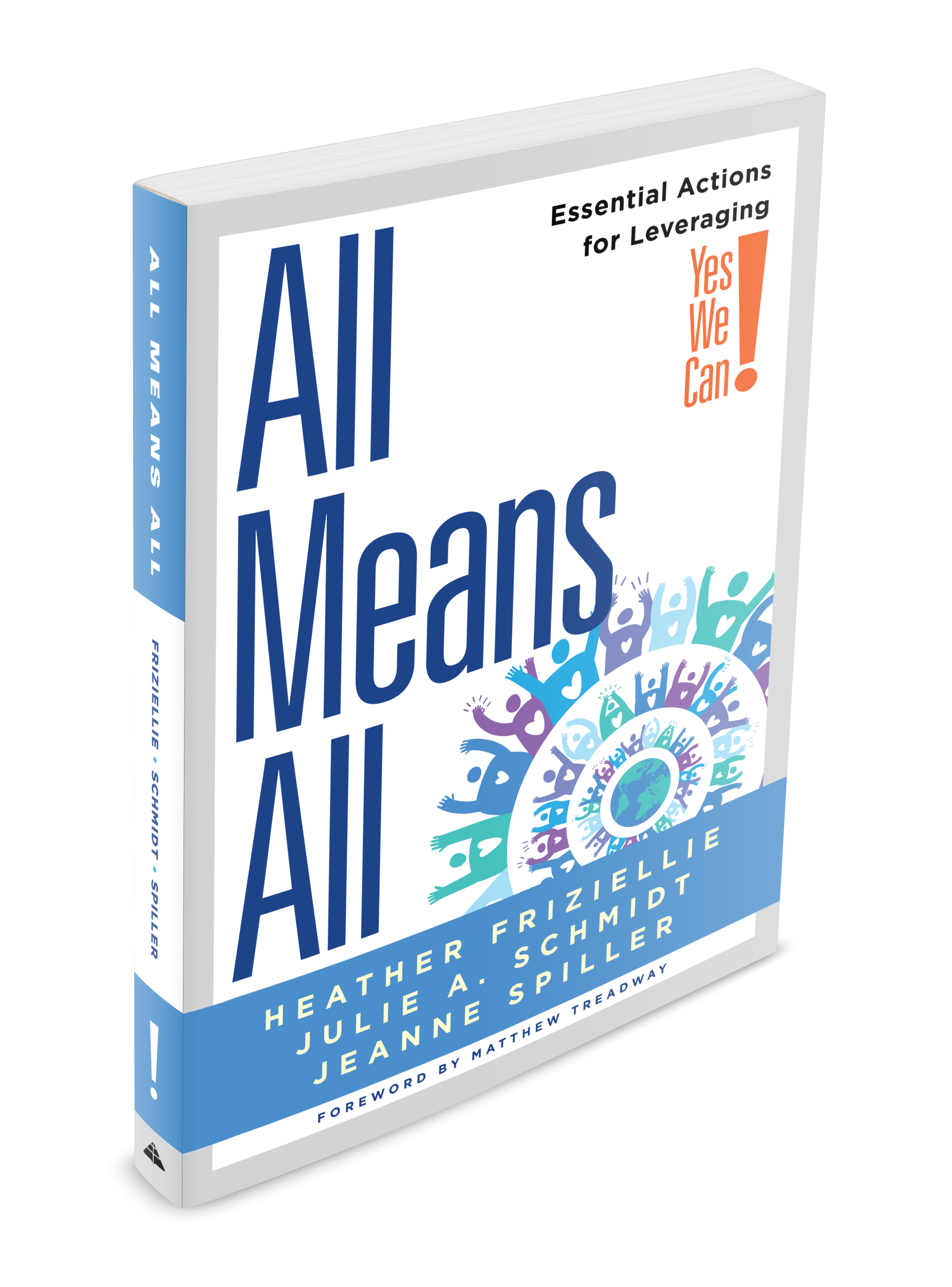 Inclusion begins by recognizing all students as general education students. All Means All Essential Actions for Leveraging Yes We Can! offers a practical framework for standards-based instruction, tailored support, progress monitoring, and targeted interventions to promote equitable learning for all. Order today.
About the author
Heather Friziellie serves as the superintendent of schools in Fox Lake District 114 in the northern Illinois suburbs. Her work focuses on ensuring learning for ALL in schools.
Erica Barraza currently serves as the instructional coach at Lotus Elementary School in Fox Lake, Illinois. With more than 15 years of experience in education, she specializes in providing effective professional learning opportunities to educators.
Reference: