
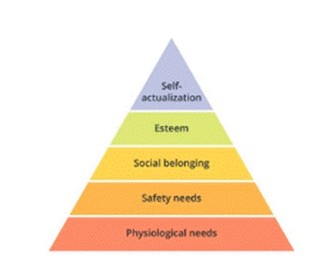
 Educators understand the importance of meeting student needs, but do we fully understand the impact of meeting our own needs to be better professionals? Maslow’s Hierarchy of Needs (Maslow, 1943) presents these needs in a hierarchical pyramid. The 3rd rung of the pyramid is our need for love and belonging.
Are we, as educators, taking the time to improve our friendships, intimate and family relationships? Up to 77% of educators report being depressed or having depressive symptoms during the school year (Agyapong, 2022). We, as educators, may not be meeting our own connection needs! Let’s take a look at ways to change that.
Strong connections lead to a stronger you
Tending to personal relationships can often get pushed to the wayside. It might be because we expend a great deal of emotional energy at school or due to time constraints. Prioritizing relationships with our friends and family nourishes our sense of love and belonging. Practical ways of doing this might include calling a family member or friend every Wednesday on your way home from school, starting a weekly book club, or scheduling a dinner with those you love. Relationships hinge on communication. If any of your relationships are struggling, consider increasing the frequency or changing how you communicate.
The life of an educator can be filled with love and a sense of belonging, but it can also feel lonely and tiresome. To maintain joy in our work, it is important to focus on friendship and connection. After all, working in schools is often like having a second family.
Rebuilding connections in a busy educator’s life
We are social beings. We need each other and were never intended to live in isolation. With the fast-paced nature of our job and the feeling of “more to-do than today,” we unintentionally let relationships fall by the wayside.
Being a part of a professional learning community isn’t just about instruction and assessment. It is about creativity, connection, and time together. It is time to get intentional about your relationships. Some ideas might include meeting with your school colleagues to schedule a dinner date or set up a monthly book club.
Asking a teacher friend to walk and talk together during a prep period or after school is a great way to connect. Further, expand your commitment to get involved with school activities, perhaps helping with logistics for a club or sport. Staying connected with your school is a wonderful way to create a sense of belonging.
Building your community on the outside
However, your friendship and connection don’t have to be just at your school or district.
You can create an even larger sense of community by forming connections with people outside of work who share your likes/dislikes. Perhaps take a cooking class, go for a hike, or walk with an old friend you have lost touch with. Commit to doing something weekly that helps you build or deepen friendships.
Maybe it’s calling your cousin and sibling once a week to share what’s new in each other’s lives. Luckily, when it comes to connection activities, there are endless possibilities.
Great PLCs are built on healthy communication
Part of connecting with others is how we communicate. How families communicate can often make or break a joyful experience. Let’s focus on what healthy communication looks and feels like to help us feel more secure in our Professional Learning Communities at Work®. Skillful communicators embed their shared mission into their messaging. They can effectively communicate the how, why, and when of any content.
Trust builders create a sequence of opportunities to show up and build positive relationships. They become impeccable with their word. Capacity builders see potential in others and create conditions for them to collaborate and improve. A results-oriented mindset drives impactful decisions that align with the organization’s mission, vision, and values. Being courageous enough to challenge the status quo and inspire change is a skill of the heart.
The art and skill of healthy communication
All of these overlapping mental models are the principles that guide educators, yet there is one additional important component to address. It is the art and skill of healthy communication. One approach is to incorporate the healthy goals of dialogue (Patterson et al., 2012), which can be summarized as maintaining a conversation with the best possible outcomes. First, let’s discuss the word dialogue. Healthy dialogue is when you don’t let people assume that dialogue equates to decision-making; rather, it is a process for distilling all relevant meaning into a shared understanding.
Healthy dialogue helps us reach consensus-based decision-making. The goals of a healthy dialogue are to learn, seek the truth, produce results, and strengthen relationships. When your goal in every conversation, big or small, is to focus on and explicitly acknowledge the healthy goals of dialogue, the parties have a much better understanding of the purpose and outcomes. On the flip side, the goals of an unhealthy dialogue are to win, be right, get even, punish, blame, or avoid conflict.
Let’s be honest. How many times in your professional day do you find yourself either seeking to win, be right, look good, get even, punish, blame, or avoid conflict?

How teams make better decisions together
In healthy team decision-making processes, it also helps to have a way to gather transparent feedback from the group. One effective approach is the consensus decision-making model. Group decisions are made using the consensus model. Consensus is reached when all points of view have been heard and the group’s collective will is clear—even to those who may disagree.
When discussing a proposal, team members can indicate their level of support using a simple scale. This is not a majority vote; it is a consensus-building process known as the Fist to Five protocol (DuFour, 2024).
Fist to Five Protocol
- Five fingers: I love this proposal. I will champion it.
- Four fingers: I strongly agree with the proposal.
- Three fingers: The proposal is okay with me. I am willing to go along.
- Two fingers: I have reservations and am not yet ready to support this proposal.
- One finger: I am opposed to this proposal.
- Fist: If I had the authority, I would veto this proposal, regardless of the will of the group.
This type of collaboration happens every day in schools and districts. While collaboration can be simple in structure, it can be challenging when conversations are driven by the goals of unhealthy dialogue.
Strong teams approach every conversation as an opportunity to learn, seek truth, produce results, and strengthen relationships–creating space for genuine thinking together.
What strong teams are built on
When we look to build a strong team, we must recognize the importance of developing strong individuals. Every human needs to feel a sense of love and belonging.
We do this by building strong friendships and connections, which hinge on healthy communication. This applies to both your personal and professional relationships. Personally, we look for ways to spend time with loved ones and improve communication. Professionally, we can use strategies such as healthy dialogue goals and the fist-to-five protocol to create safe spaces and strong communication.
When we start at the bottom of Maslow’s Hierarchy of Needs and work our way up, we will take a thorough approach to building a strong self and a strong team.
About the educator
Dr. Aisha Thomas has been an educator for over 20 years, serving in all levels of school leadership at the middle school and elementary levels. She has helped lead two schools to receive the National Blue Ribbon Award.
Becky Jo Oglesby has 12 years as an elementary educator experience and is in her third year as an administrator. She leads trauma-informed professional development across all educational levels through Capes in the Classroom. Becky Jo was also named the 2020 Oklahoma Teacher of the Year.