

(Hint: It’s More Than Just The Literacy Curriculum)
Raise your hand if improving student reading achievement is one of your top three school improvement goals. Now put a finger down if it was also a goal on last year’s school improvement plan. Put another finger down if your school or district adopted a new literacy curriculum in the last few years to better align literacy instruction to emerging research.
Now, put another finger down if teachers received cursory training in implementing the new curriculum and were then told to use it with fidelity. Put that final finger down if, at a recent meeting, you looked at student data highlighted in yellow and red and felt your hope fading that this will be the year we finally send more students to the next grade reading proficiently. Sigh.
As a literacy instructional coach who has traveled to hundreds of schools and districts in 24 states, I’ve found five essential questions we need to ask ourselves to turn our school improvement plans into meaningful results—and finally crack the code on accelerating literacy for all students.
1. Are teachers being students of the standards, developing knowledge of the most essential components of literacy? Or do we rely on surface level familiarity with a purchased curriculum to meet the complex literacy needs of our students?
Real literacy growth isn’t found in a curriculum box
If a curriculum, resource, or program existed that could teach all children to read, we’d all be using it instead of adopting new high-quality instructional curricula every few years. Literacy learning is a complex process. To achieve equitable outcomes, we must invest in building the capacity of teachers who guide students through becoming literate.
Teams need collaborative time to engage in the work that has the greatest impact on student learning, which means they must become students of the literacy standards before they can expect to bring more students to those standards (Maeker & Heller, 2023).
Teachers should:
- Identify essential standards for their grade
- Clarify the rigor expected for each standard
- Discuss potential stumbling blocks to help students anticipate difficulties
- Break standards into learning targets and map them across the year to ensure students reach proficiency
The reading curriculum has many embedded, recursive standards, so teams need clarity on when and how to elevate their essential standard learning targets within the curriculum to accelerate their students’ learning of those essentials.
“If a standard spans more than a single time frame, teams should clarify which specific targets from the standard students should be proficient with by each date (that is, benchmark the progression of learning into smaller chunks of time)” (Kramer & Schuhl, 2023 p 38).

2. Have teachers studied the curriculum for the best opportunities to practice essential literacy skills to proficiency?
Using your literacy curriculum to maximize student growth
There is a difference between “doing” a curriculum and “using” a curriculum. Teachers told to “do it with fidelity” often feel handcuffed to be on page 28 on the 28th day of school. But when the expectation shifts to “use it with integrity” in service of essential standards, teams become empowered instructional decision-makers who can better meet students’ needs.
Literacy curricula are designed to continually spiral back to previously taught skills so that students can integrate them into increasingly complex texts throughout the year. For students reading below grade level, exposure to a skill only a few times across units isn’t enough.
Teachers need to:
- Integrate prerequisite skills alongside grade-level content
- Tweak instruction to maximize opportunities for proficiency
- Make learning targets explicit, so students know what skill they are mastering (for example, using nonfiction text features to locate information), not just the task they are doing (like reading about tornadoes
“Every lesson plan starts with a lesson goal – an understanding of what students must learn by the end of the lesson related to a grade-level standard. …Teacher clarity grows student clarity and gives purpose to each lesson and assignment” (Kramer & Schuhl, 2023 p 91).

3. Are teachers using gradual release to scaffold, build reading stamina and support students to independence? Or are we stealing productive struggle, fostering more learned helplessness and just focusing on task completion?
How to keep standards high for every learner
Students currently reading below grade level do not think below grade level, so their comprehension expectations should not be lowered (Maeker & Heller, 2023). When teachers have many students reading below grade level, they often read passages aloud and answer questions together as a whole group because too many students wouldn’t be able to decode the text or complete the task on their own. This sends a message of “I don’t think you can handle this,” fostering learned helplessness.
Instead, teachers should:
- Build learning progressions
- Identify scaffolds
- Model strategies before students practice independently
- Use structured talk, turn-and-talks, and accountability to deepen understanding in every lesson and ensure students know that learning is not optional
“When planning for engagement in lessons, consider ways students can do more of the work and thinking than the teacher during a lesson” (Kramer and Schuhl 2023, 101).
4. Do we seek meaningful feedback from targeted formative assessments that make literacy learning visible? Or are we assessing too many skills at once for the data to be actionable with an overreliance on screeners and big data?
Leverage student data for classroom success and growth
Literacy teachers are no strangers to assessment, but large-scale district or state tests rarely provide timely feedback on what students have learned in recent lessons. To truly support learning, we need to know which students actually learned the intended outcomes from the past few days or weeks, so teachers can respond with targeted reteaching aligned to clear learning targets.
Students should also monitor their progress using learning targets and goal-setting tools, which help them take ownership of their growth.
For example, the 4th-grade team’s end-of-unit assessment may include 10 questions, with 3, 4, and 7 measuring a specific skill: making inferences and supporting them with evidence. A student might score a 6/10 overall but earn a 3/3 on that essential skill. This allows us to celebrate true mastery while avoiding unnecessary intervention– ensuring support is targeted where it’s actually needed.
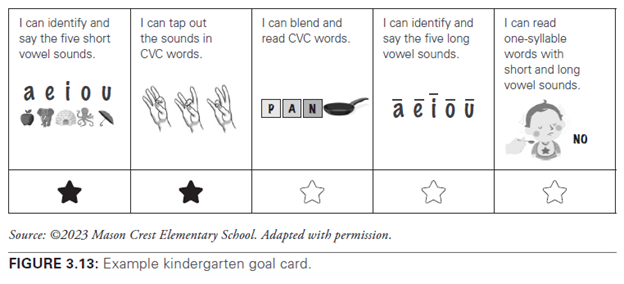
That kind of targeted feedback helps students monitor their progress and set meaningful goals, and can be made even more powerful when made visible through tools like student goal cards, such as this example from Literacy in a PLC at Work® (Maeker & Heller, 2023).
5. Is there time in the instructional block to apply the reading skills taught in continuous and complete texts? Or has increased focus on foundational skills led to a decrease in time with books, reading only excerpts or passages?
What gets lost in literacy shifts–and how to fix it
Many districts have invested in the science of reading training and revamped their literacy curriculum, yet aren’t seeing the results they expected. One reason may be that we swing on the pendulum without noticing what gets lost along the way.
When the need for stronger phonemic awareness and phonics instruction became clear, many teachers reduced read-alouds and small-group instruction to make room for a newly adopted, systematic curriculum.
Later, when the focus shifted to building knowledge and vocabulary, time was reallocated again—this time toward science and social studies—often at the expense of modeling comprehension strategies and giving students time to practice them in text.
These shifts were necessary. But in the process, one critical element has been diminished: students’ time to actually read and engage with real, connected texts where they can integrate and apply skills. Because marking syllable types is not the same as reading multisyllabic words. Identifying the theme in a short excerpt is not the same as sustaining understanding across a full-length text.
If we want to build truly literate students, we must ensure they have consistent opportunities to apply what they’ve learned in authentic reading experiences—so they can become confident, capable readers in the real world.

Growth starts with honest conversations
Are you ready to tackle these five guiding questions with your staff? When we take an honest look at our current reality, engage in the hard conversations, and invest time in building teacher capacity around literacy—while also helping students see themselves as capable readers who can apply what they’ve learned—we all grow as readers and learners.
That’s how acceleration for all happens.
About the educator
Jacqueline Heller focuses on building capacity and collective efficacy with teachers to ensure all students learn at high levels. As a literacy teacher and coach at Mason Crest Elementary, she helped the school become the first National Model Professional Learning Community to receive the DuFour Award.
References
Kramer, Sharon V., and Sarah Schuhl. Acceleration for All: A How-To Guide for Overcoming Learning Gap. Solution Tree Press, 2023.
Maeker, Paula, and Jacqueline Heller. Literacy in a PLC at Work®: Guiding Teams to Get Going and Get Better in Grades K–6 Reading. Solution Tree Press, 2023.