
If you’ve ever tried to use Depth of Knowledge (DOK) in your classroom, you’ve probably noticed something frustrating: the labels don’t always tell the whole story. “Recall,” “Skill/Concepts,” “Strategic Thinking,” and “Extended Reasoning” sound simple enough—but what do they really mean for teaching and learning?
The DOK Update
Recently, Dr. Norman Webb, the creator of DOK, updated his DOK Primer to clarify the concept. Webb explains that he originally developed DOK as a “language system for evaluating the relationship between the complexity of academic standards and the complexity of corresponding assessment items” (Webb, 2025, p.1). His four DOK Levels are labeled as:
- DOK 1: Recall
- DOK 2: Skill/Concepts
- DOK 3: Strategic Thinking
- DOK 4: Extended Reasoning
While these labels are straightforward, they’re also easy to misinterpret. For instance:
- Does Recall (DOK 1) mean students never analyze or create?
- What exactly does Skill/Concept (DOK 2) look or sound like from a learner’s perspective?
- How is Strategic Thinking (DOK 3) meaningfully different from Extended Thinking (DOK 4)–beyond the amount of time it takes to address and assess the learning expectation?

Why DOK labels don’t translate easily to classroom practice
Webb provides detailed definitions and subject-specific examples in his papers and primers. These are excellent for checking the alignment of standards, activities, and assessments–the original purpose of DOK. But they don’t always show what learning actually looks, sounds, or feels like in the classroom.
To complicate things, countless resources like books, visuals, and even generative AI resources offer DOK examples that are inconsistent and inaccurate. Teachers often struggle to translate DOK labels into meaningful classroom experiences.
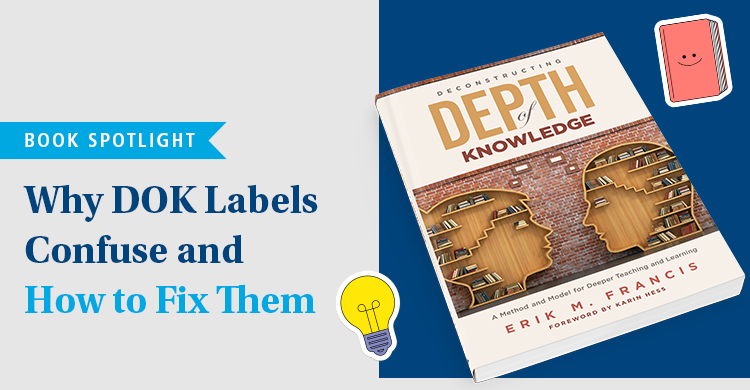
 experiences that engage, challenge, and support all learners—academically, socially, and emotionally in Deconstructing Depth of Knowledge
What DOK Descriptors look like in action
In my book Deconstructing Depth of Knowledge, I developed DOK Descriptors to make the levels more tangible. These descriptors show exactly what students must demonstrate and discuss at each level. They make expectations visible and measurable, aligning with John Hattie’s idea that learning is most powerful when teachers “see learning through the eyes of the students, students become their own teachers, and teachers become their own students.” (Hattie, 2023).
The descriptors clarify three aspects of learning:
- What learning sounds like (DOK Response)
- What learning looks like (DOK Skill)
- What learning feels like (DOK Demand)
Here’s a quick look:
The Language of Depth of Knowledge (updated from Francis, 2022)
| Webb’s Levels | DOK Response | DOK Skill | DOK Demand |
| DOK 1
|
Answer correctly | Recall how to
Recall information |
Simple |
| DOK 2 | Establish and explain with examples
Establish and express with examples |
Apply knowledge, concepts, or skills
Use information and basic reasoning |
Complex |
| DOK 3 | Employ and explain with evidence
Examine and explain with evidence Examine and explain with evidence |
Think strategically
Use complex reasoning |
Involved |
| DOK 4 | Explore and explain for an extensive purpose
Extend and explain for an extensive purpose |
Think extensively
Use extended reasoning |
Extensive |
What does learning sound like?
The DOK Response descriptors specify the extent of the response students must provide, making depth and rigor visible.They can also serve as the success criteria for student performance. For example, teachers can deepen the demand or raise the rigor of the DOK 1 activity to a DOK 3 by engaging students to evaluate and explain with evidence why their answer is accurate.
- DOK 1: Students give a correct answer–a single word, term, or calculation.
- DOK 2: Students establish, explain, or express with examples, summarizing or synthesizing ideas. They must also use the ideas, information, or items from the curricular resource or assigned text as examples to strengthen and support their responses.
- DOK 3: Students provide evidence to support reasoning, analyzing and evaluation concepts or action.
- DOK 4: Students explore or extend ideas across multiple contexts, connecting information from texts, topics, or disciplines.
What does learning look like?
The DOK Skill descriptors clarify the demand of the mental processing students must do: recall, apply, think strategically, or think extensively. They can be integrated into learning targets to make expectations more specific, measurable, and visible for both teachers and students.
- DOK 1 (Recall how to): Students identify or recognize information to answer correctly. “I can recall how to analyze whether the information is in the text.”
- DOK 2 (Use information and basic reasoning): Students explain their thinking and apply knowledge using examples from the text. “I can use information and basic reasoning to analyze how the information is presented in the text.”
- DOK 3 (Use complex reasoning): Students support their analysis with evidence, justifying conclusions or interpretations: “I can use complex reasoning to analyze how the information supports the central idea of a text.”
- DOK 4 (Use extended reasoning): Students synthesize and compare ideas across multiple texts or contexts for a broader purpose: “I can use extended reasoning to compare information across multiple texts.”

What does learning feel like?
The language of DOK also elaborates how learners may perceive a learning expectation or experience. These DOK Demand descriptors capture both the academic challenge and the learner’s perception of the task.
- Simple (DOK 1): Students recall or restate facts or how to perform procedures
- Complex (DOK 2): Students demonstrate and discuss conceptual and procedural understanding. Performing multiple steps is a characteristic of DOK 2 activity, item and task. However, it’s not a criterion. What distinguishes a DOK 2 is that students must use multiple processes or skills (not actions) in a certain context or for a particular purpose.
- Involved (DOK 3): Students use evidentiary reasoning to strengthen and support responses, results or reasoning–be it their own or those presented by others.They analyze impacts,consider implications, and think critically and creatively about how learning applies across contents.
- Extensive (DOK 4): Students are encouraged to apply learning deeply and purposefully–across texts, topics, curriculum, or real-world contexts. DOK 4 activities, items, and tasks typically take an extensive time to complete. However, time is a characteristic, not a criterion.
Rethink Depth of Knowledge and make learning visible. Learn how to apply DOK effectively in your classroom with Erik M. Francis’s insights and free reproducibles. Read the blog >>
Why a common language of learning is important
DOK descriptors aren’t just a rubric–they’re a shared language. Teachers can use them to:
- Clarify student expectations during collaborative team meetings
- Embed the DOK Skill and Response directly in learning targets
- Explain student performance to colleagues, students, and parents.
Imagine telling a parent: “Yes, your child did answer correctly. However, the objective was to evaluate and explain with evidence why their response was correct.” That clarity transforms understanding of learning.
When used this way, Depth of Knowledge extends well beyond its original purpose. As a common language, DOK strengthens alignment, clarifies rigor, and makes expectations for deeper learning more visible and accessible–allowing the entire school community to talk about learning with greater precision and a shared understanding.
About the Educator
Erik M. Francis is an international author, educator, and presenter. He provides professional development on how to plan and provide engaging teaching and learning experiences that are academically rigorous, socially and emotionally supportive, standards-based, and student responsive.