
Too many secondary students are sitting in classrooms without truly learning how to read.
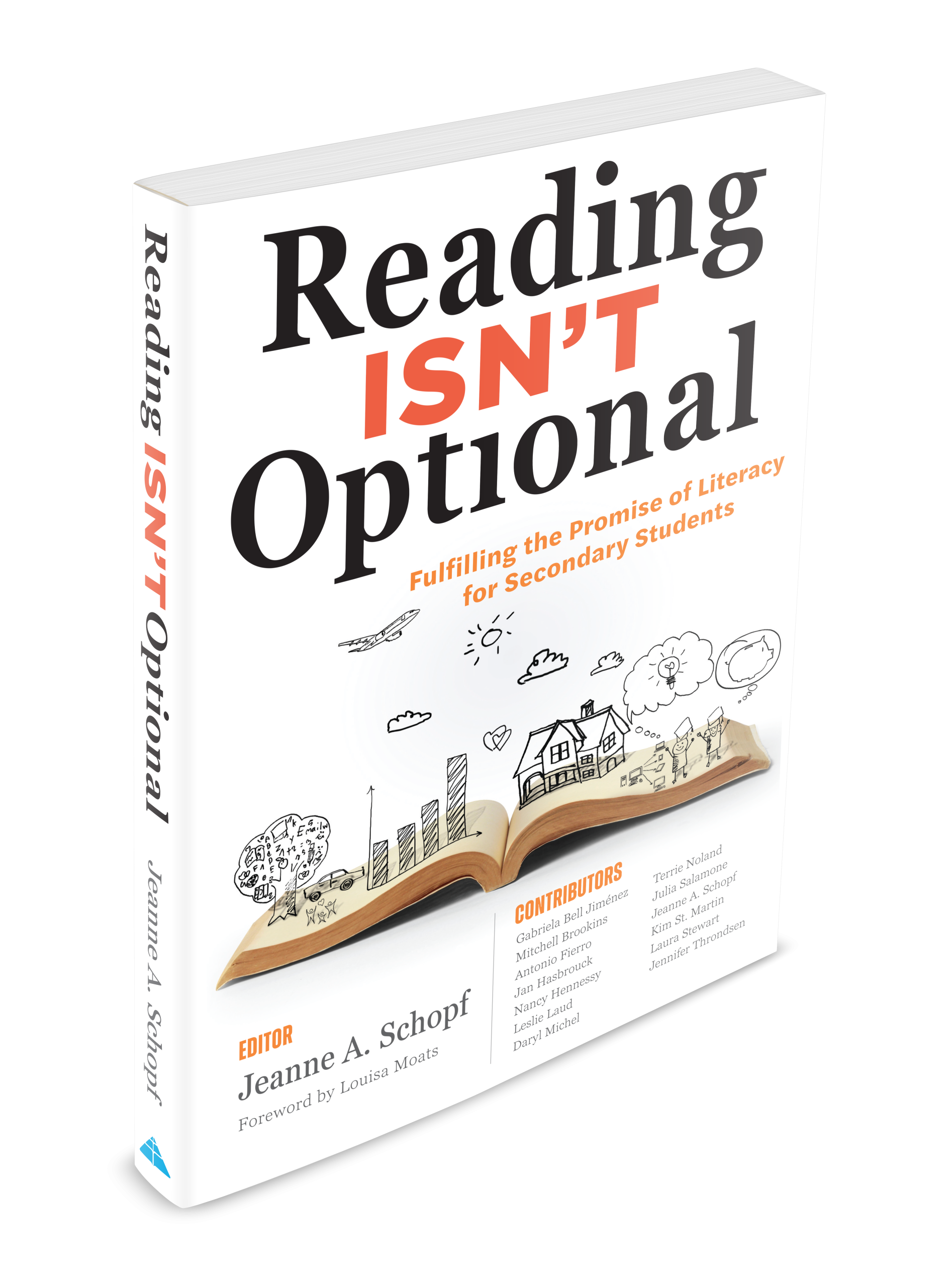 Discover how Jeanne A. Schopf’s book Reading Isn’t Optional is reshaping secondary literacy through the science of reading and explicit instruction. Grounded in research and classroom practice, this book offers explicit, actionable strategies to strengthen fluency, vocabulary, and intervention. It provides a clear pathway for middle and high school students to move beyond reading roadblocks and toward deeper comprehension and lifelong literacy success. Read on to hear insights on literacy, instructional shifts, and what it really takes to help secondary students become confident, capable readers.
Check out our exclusive Q&A with literacy expert Jeanne A. Schopf
Q: Secondary literacy can be a gateway or a roadblock for students. How does Reading Isn’t Optional help educators navigate these high-stakes challenges in real classrooms?
JS: I recall a time when my students stared blankly at their novels. Although they seemed to be reading, many ultimately failed the assessment. Despite my efforts to teach the required standards and provide a study guide, the students were disengaged. I assumed their lack of engagement was due to a lack of motivation. However, a year later, after learning about the science of reading, I came to understand that I hadn’t adequately addressed the linguistic and cognitive demands necessary for comprehension. They had significant gaps in their foundational skills, which meant that their inability to engage and succeed wasn’t due to a lack of motivation, but rather a lack of skill.
Your student’s aren’t lacking motivation
In the secondary classroom, we often misinterpret a skill gap as a will gap. We assume that because students are older, they possess the foundational skills needed to decode and make sense of complex academic language. In reality, many students experience hidden decoding breakdowns that interfere with their ability to process sophisticated text. When explicit instruction is not provided to address these needs, students disengage not out of apathy, but because the task feels unattainable. They are not lacking motivation; they are lacking the skills necessary for success. Without strong, systematic support in many middle and high schools, these students are too often overlooked.
This book addresses that gap effectively. Literacy leaders from various domains have collaborated to offer readers not only evidence-based literacy practices for secondary classrooms but also a comprehensive blueprint for transforming literacy that could change the lives of our secondary students.
Q: What drives your passion for adolescent literacy, and how has your experience shaped the way you approach teaching and supporting secondary readers?
JS: My greatest teachers have been my two daughters and my students. Raising children with neurodiverse brains made their experiences in school more challenging than necessary, particularly in a secondary education system that often adheres to traditional instructional methods. Teaching middle and high school English Language Arts and serving as an interventionist proved transformative for me.
I will never forget one student who, amid tears and frustration, cried out in class, “I have felt so dumb my whole life.” As a middle school teacher and interventionist, I witnessed numerous students struggle with reading and writing. Lacking training in explicit instruction and a deep understanding of the complexities of reading left me uncertain about how to provide the support my students needed.
Nurture your student’s confidence
JS: That moment highlighted the invisible burden many of our older students carry. When a student reaches secondary school without a solid foundation in literacy, the challenge extends beyond academics; it becomes emotional. Many develop “masking” behaviors, choosing to appear indifferent or defiant because it feels safer than admitting they struggle to keep up. I realized we cannot simply focus on the mechanics of reading; we must also nurture the student’s confidence.
It’s essential to shift the narrative so that they understand their past difficulties do not reflect their intelligence, but rather indicate that they have not yet been given the right tools. We need to combine high-level instructional practices with a supportive environment, showing readers that it is never too late to grow, while ensuring they never feel diminished or compared to their peers in ways that create shame.
Observing adolescents carry shame stemming from inadequate systems and instruction has shaped my life and this text. Every child has the right to read. If secondary schools do not ensure literacy for all, who will?

Q: For educators feeling overwhelmed, what is one strategy or mindset shift you’ve seen that teachers can begin using immediately to support secondary readers?
JS: Secondary teachers are trained in literature, not literacy. This reality calls for a shift in how we view middle and high school students: they are fully capable of learning foundational reading and spelling skills. When students struggle, it is not a reflection of their intelligence or motivation, but often a result of limited success that erodes their confidence. The first challenge is acknowledging unfinished learning.
I’ve seen that when we stop viewing literacy as an added task and start recognizing it as the vehicle for teaching our content, the sense of overwhelm begins to lift. One of the most accessible, evidence-based shifts for many teachers is in vocabulary instruction. The most immediate win comes from moving beyond simply defining words to exploring how words work, helping students navigate morphology, use context, and understand multiple meanings.
This does not require a complete curriculum overhaul; it calls for intentionality in the words we choose and how we introduce them. When we provide this level of clarity, we are not just teaching a list of terms; we are equipping students with a lasting toolkit to make sense of the next complex text they encounter independently.
Once teachers understand it, they can implement explicit vocabulary instruction that addresses all aspects of word learning, leading to immediate gains in student success, confidence, and motivation.
Q: You cover topics from fluency to multilingual learner support to writing integration. How do these interconnected strategies help students become independent, confident readers?
JS: Improving literacy outcomes for secondary students requires a comprehensive and cohesive approach. Reading and writing are interconnected language systems that depend on explicit, responsive instruction. Fluency serves as a bridge to comprehension, and when students do not understand a text, fluency is often a contributing factor. When teachers understand the complexities of fluency, they are better positioned to help students access grade-level texts while also building confidence and motivation.
As a teacher and interventionist, one of the most challenging aspects of my work was supporting multilingual learners. Because of the demands of secondary content, effectively serving these students requires well-prepared teachers working within a robust system of support to ensure their needs are consistently met with expertise. This text offers support to teachers for our English Language Learners, which I would have appreciated.
It became clear to me that fluency, writing, and vocabulary are not separate subjects to be taught in isolation, but rather the scaffolding that supports a student’s ability to think critically. In secondary classrooms, we often ask students to complete complex tasks such as analyzing a theme or constructing an argument in writing, without recognizing that breakdowns in linguistic processing are often what block their progress.
Helping teachers, helps secondary students
JS: When we intentionally integrate these linguistic processes, we ensure that a student’s difficulty with decoding or language does not prevent them from engaging with high-level ideas. By providing this multilayered instruction, we remove barriers to accessing complex texts and help students move from simply getting through a reading to truly owning the information.
Empowering teachers within strong systems, guided by literacy leaders dedicated to ensuring students achieve proficiency in reading and writing, is the critical work ahead. As one high school English teacher noted after listening to a fluency podcast, “This helped me understand the concept of fluency.” Teachers genuinely want what is best for their students, making it essential to bridge the gap between content-area teachers and those focused on literacy instruction.
Our goal is to cultivate independent and confident readers. Robust systems, grounded in the science of reading and supported by knowledgeable leadership, empower teachers to help students realize their full potential.
About the educator
Jeanne A. Schopf, MEd, has worked across K–12 settings to improve reading outcomes for all students grounded in the science of reading, structured literacy, and multitiered systems of support, with an emphasis on evidence-based instruction and sustainable schoolwide change.