

 CAN
CAN  US/Global
Free Reproducibles
The Handbook for Design in Five
Assessment Tools and Protocols for Teachers and Teams
Make assessment meaningful, doable, and intentional. This practical companion handbook to the Design in Five, Second Edition, gives teachers simple assessment protocols, editable templates, and artificial intelligence support to drive the Design in Five process. Revolutionize assessment from standards to grading reform and student reflection.
Benefits
- Examine, identify, and select relevant educational standards to guide learning goals
- Analyze standards to create a clear learning progression across curriculum design
- Develop an assessment plan to measure student growth along learning progressions
- Create assessments according to criteria that align with target learning goals
- Engage students in continued learning through reflection, feedback, and clear test scoring
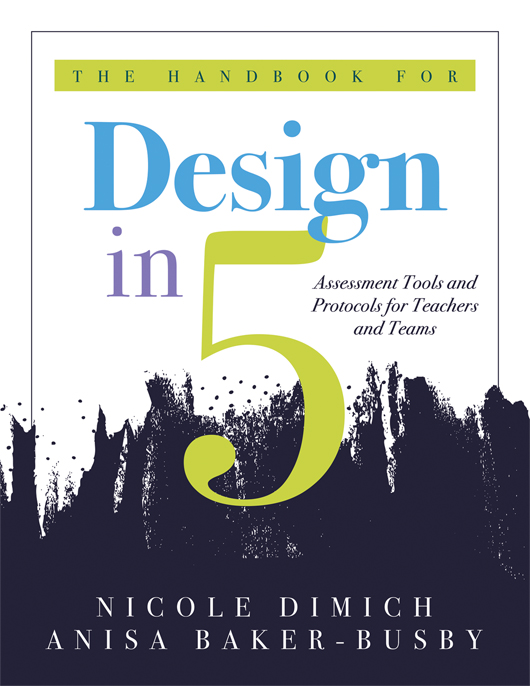
TABLE OF CONTENTS
Phase One: Choosing Standards and Planning Engagement
Phase Two: Analyzing Standards and Constructing Learning Progressions
Phase Three: Crafting an Assessment Plan
Phase Four: Creating the Assessment and Gathering the Materials
Phase Five
Part 1: Designing a Scoring Scheme
Part 2: Building a Student-Reflection Tool
Part 3: Collaborating on Data and Student Work Analysis
Part 4: Using Assessment to Build Student Partnership
REPRODUCIBLES
Phase One: Choosing Standards and Planning Engagement
Phase Two: Analyzing Standards and Constructing Learning Progressions
- Phase Two: Analyzing Standards and Constructing Learning Progressions
- Figure 2.1: Second-Grade Reading Standards Analysis
- Figure 2.3: Sixth-Grade Social Studies Standards Analysis
Phase Three: Crafting an Assessment Plan
Phase Four: Creating the Assessment and Gathering the Materials
- Multiple-Choice Item Template
- Constructed-Response Template
- Performance Assessment Task Template
- Performance Assessment Task Quality Checklist
- Figure 4.1: Social Studies Constructed-Response Sample
- Figure 4.3: Third-Grade ELA Assessment
Phase Five: Part 1
- Figure 5.1.1: Cover Page Example
- Phase Five, Part 1: Designing a Scoring Scheme Template
- Protocol and Template for Designing a Rubric
- Figure 5.1.4: Sample First-Grade Mathematics Cover Page
- Figure 5.1.6: Sample Third-Grade Assessment Cover Page
- Figure 5.1.7: Sample Fifth-Grade ELA Assessment Cover Page
- Figure 5.1.8: Sample Eighth-Grade Geography Assessment Cover Page
- Figure 5.1.9: Sample Secondary Biology Cover Page
Phase Five: Part 2
- Figure 5.2.3: Sample Second-Grade Student Self-Assessment
- Figure 5.2.4: Sample Elementary Literacy Constructed Response
- Figure 5.2.5: Sample Second-Grade Student Goal Setting Sheet
Phase Five: Part 3
- Analyzing Student Work to Plan Instruction
- Analyzing Data by Student and Standard (Common and Collaborative)
- Figure 5.3.2: Sample Seventh-Grade Justification and Evidence
- Figure 5.3.3: Sample Kindergarten Mathematics Student Work Analysis and Instructional Plan
Phase Five: Part 4
- Using the Three Focus Questions to Plan for Student Investment
- Reflect on Student Partnership Strategies
Appendix A: Implementation Guides
- Quality Check for Precision
- Quality Check for Action
- Quality Check for Student Investment
- Design in Five Implementation and Reflection Guide
Appendix B
- Design in Five Unit Template
- How to Implement AI-Enhanced Tools in Your Practice by Category
- Potential Access Point Ideas to Support All Learners
SUGGESTED RESOURCES
BOOKS
- Chapman, C., & Dimich, N. (2011). Motivating students: 25 strategies to light the fire of engagement. Solution Tree Press.
- Dimich, N. (2024). Design in Five: Essential phases to create engaging assessment practice (2nd ed.). Solution Tree Press.
- Francis, E. M. (2022). Deconstructing Depth of Knowledge: A method and model for deeper teaching and learning. Solution Tree Press.
- Marzano, R. J., Parsley, D., Gagnon, D. J., & Norford, J. S. (2020). Teacher as researcher. Marzano Resources.
- Mattos, M., Buffum, A., Malone, J., Cruz, L. F., Dimich, N., & Schuhl, S. (2025). Taking action: A handbook for RTI at work (2nd ed.). Solution Tree Press.
- Schimmer, T. (2016). Grading from the inside out: Bringing accuracy to student assessment through a standards-based mindset. Solution Tree Press.
WEBSITE
Phase Three
- ChatGPT
- Claude
- MagicSchool
- Gradescope
- Microsoft 365 Copilot Chat
- Conker
- Education Copilot
- Curipod
- Formative AI
- Canva Magic Write
- Notion
Phase Five: Part 2
Phase Five: Part 4
Appendix A


