

 US/Global
  CAN
CAN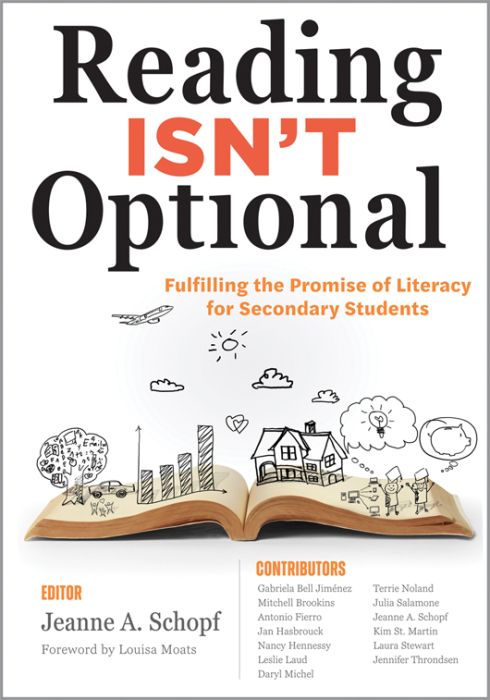
Reading Isn’t Optional
Fulfilling the Promise of Literacy for Secondary Students
Designed for secondary educators, this book bridges literacy research and classroom practice. Featuring expert voices on MTSS, coaching, leadership, and evidence-based reading and writing instruction, it equips schools to build systems that improve literacy development, reading comprehension, and more.
Maximize secondary literacy with evidence-based practices.
Coauthor and editor Jeanne A. Schopf brings together leading literacy experts to address one of secondary education’s most significant gaps: teaching adolescents to read. Grounded in literacy research and implementation science, this book guides middle and high school educators through systems, leadership, MTSS, and evidence-based instructional practices that transform literacy development for struggling readers, including multilingual learners, across all content areas.
Grades 6–12 teachers, leaders, and instructional coaches can use this book to:
- Implement multitiered systems of support to teach literacy actively across all disciplines in secondary education
- Encourage teachers and train them in effective literacy instruction through peer coaching
- Adopt new strategies to improve student reading fluency, comprehension, and vocabulary
- Reinforce students’ literacy training through reflective writing and class discussions
- Adapt practices as needed to address unique needs and support multilingual learners
Related Topics
InstructionLiteracySchool Improvement
Additional Information
“This book is not theoretical to me—it is personal. I watched the lack of explicit instruction do more than hinder reading—it altered how my son saw himself and what he believed he was capable of. Through my advocacy, I continue to see that same failure repeat itself, child after child. In her foreword, Louisa Moats reminds us that allowing a student not to learn to read should never be an option; this resource ensures it isn’t. Jeanne Schopf and her contributors show us that older struggling readers are not broken—they were simply not taught.
“We cannot keep handing students diplomas when we failed to give them literacy.”
“Jeanne Schopf recognizes the yearslong decline in adolescents’ reading comprehension and urges educators to look past myths to create a shift in mindsets—a shift that, according to Schopf, ‘will help create a classroom environment where all students can reach their hidden potential.’ The information in this book is highly beneficial for educators and education leaders. My favorite things about this book are the different points of view from education professionals, which highlight the challenges, strategies, and workable, equitable solutions for secondary literacy.”
“Reading Isn’t Optional makes an important contribution to the conversation about literacy by focusing on students who too often reach middle and high school without the reading skills they need to succeed. This book invites educators to rethink what we believe about reading instruction in secondary classrooms and offers clear knowledge, practical structures, and step-by-step guidance for teachers, coaches, and leaders. A timely and necessary resource for anyone committed to ensuring literacy truly is not optional for any student.”
“This practical text is destined to become a go-to resource for secondary educators on using implementation science, MTSS, and instructional coaching to bridge the gap between research and practice in secondary schools. The book will be a welcome addition to resources for pre-service and in-service training of secondary teachers and administrators.”
“This is the book that secondary teachers have been waiting for! They’ve heard that ‘every teacher is a reading teacher,’ but until now there hasn’t been a guide to show them how to make that a reality. Reading Isn’t Optional fills that gap with clear summaries of the research and step-by-step guidance. With this book as their guide, secondary teachers can finally deliver on the promise of literacy for every student.”
“RIO is an exceptional book that provides teachers of all disciplines strategies and tools to strengthen reading comprehension, understanding, and evaluation among readers who find themselves stalled or blocked in their attempts to make meaning. In the style of a vignette, each chapter highlights timely research and clear, accessible strategies from a variety of authors whose expertise and experience shines through on every page. Designed to make the best use of a teacher's limited time, each chapter highlights explicit strategies and tools scaffolding on growing reluctant readers to inquisitive thinkers. This is a must-have for every teacher's toolbox, an unrivaled resource designed to foster thoughtful, engaged, analytical, and evaluative readers.”
“I love that I can pick up Reading Isn’t Optional and have the world of secondary school literacy in my hand. This book does everything. It digs deep into those pockets of our classroom practices that we are continually improving and makes the dreams we have for that work realizable. It’s the answer to that voice in our head that wonders if we can do just a little bit more to create something extraordinary. From cross-disciplinary integration, to mental models, to scaffolding, RIO is a trusted companion for any teacher who wants to build high school literacy practices that will support our students for life.”
“As a secondary English teacher, I went back to school after the COVID lockdown to earn my master’s in education with a focus on literacy instruction after realizing that many of my students could not read well enough to learn independently. Since then, I have worked with other high school teachers to emphasize that literacy instruction is necessary in every subject area. This text is a comprehensive starting place for secondary schools to begin to close the literacy gap, and with its step-by-step guidance, grounded in the science of reading, it will enable high schools to prepare all students to become literate adults.”
“As a high school English teacher and instructional coach, I see firsthand the urgency of improving adolescent literacy and the challenge of doing so while teaching rigorous grade-level standards. Reading Isn’t Optional provides the research foundation and practical guidance educators need to make literacy a shared responsibility across secondary classrooms. It offers a clear, actionable framework that can help teachers and school leaders translate the science of reading into meaningful instruction that strengthens student literacy outcomes.”


